

Introduction
The twenty-first century has ushered in an era of
unprecedented change in the world of work, marked by rapid technological
advancement, globalization, and the emergence of entirely new industries and
professions. The World Economic Forum (2025) has documented that nearly half of
all job skills are expected to change within the next few years, and the shelf
life of technical skills continues to shrink as automation, artificial
intelligence, and digital transformation reshape the global labor market. In this
context, the ability to understand, organize, and act upon one’s interests is
no longer a luxury but a necessity for career resilience and fulfillment.
Individuals are increasingly called upon to become the architects of their own
professional journeys, navigating a landscape that is both more complex and
more opportunity-rich than ever before.
Despite the proliferation of career guidance resources,
many people still struggle to identify and pursue paths that align with their
authentic interests, values, and strengths. This challenge is compounded by the
growing diversity of the workforce and the need for personalized, adaptable
approaches to career development (Brown & Lent, 2020). The traditional,
linear model of career progression has given way to a more dynamic,
individualized paradigm, where success is defined not only by external achievements
but also by the degree of alignment between one’s work and one’s intrinsic
motivations (Ryan & Deci, 2020). In this environment, tools that facilitate
deep self-reflection, strategic planning, and adaptability are essential for
both individuals and organizations.
The OccuOri® Interest Mind Map is designed to address
these needs by providing a visually engaging, evidence-based framework for
exploring and organizing personal interests in relation to current and emerging
career trends. Drawing on foundational theories in vocational psychology,
motivation, and innovation, as well as cutting-edge visualization techniques,
the Mind Map empowers users to clarify their passions, identify patterns, and
make informed decisions about their educational and professional trajectories.
By integrating research on person-environment fit, passion, motivation,
adaptability, and diversity, the OccuOri® Interest Mind Map stands as a
powerful resource for anyone seeking to thrive in the modern workforce.
This paper provides a comprehensive examination of the
OccuOri® Interest Mind Map, beginning with an exploration of its theoretical
foundations in career development, motivation, and visualization. It then
details the structure and application of the Mind Map, highlighting its role in
fostering career adaptability and lifelong learning. The discussion further
addresses the importance of diversity, inclusion, and personalization in career
exploration, before concluding with a synthesis of the Mind Map’s impact and
its significance for the future of work. Through this analysis, the paper
demonstrates how the OccuOri® Interest Mind Map not only meets the demands of
today’s labor market but also anticipates the needs of tomorrow’s workforce.
Theoretical Foundations: Interests, Motivation, and
Visualization in Career Development
The OccuOri® Interest Mind Map is grounded in a rich
tradition of research on vocational interests, motivation, and the psychology
of career development. At the heart of this tradition is Holland’s (1997)
theory of vocational personalities and work environments, which posits that
individuals are most satisfied and successful when their work environments
align with their core interests and personality types. Holland’s RIASEC
model—comprising Realistic, Investigative, Artistic, Social, Enterprising, and
Conventional types—has been extensively validated and remains a cornerstone of
career assessment and counseling. The principle of person-environment fit, as
articulated by Holland, underscores the importance of aligning one’s interests
with the demands and culture of specific roles and organizations.
Empirical research has consistently demonstrated the
predictive power of interest–major congruence for academic and career outcomes.
Tracey and Robbins (2006) conducted a longitudinal study showing that students
whose academic majors matched their interests achieved higher grade point
averages and were more likely to persist to graduation. This finding highlights
the practical significance of interest assessment in educational and career
planning, as well as the potential costs of misalignment.
Beyond the identification of interests, the quality of
one’s engagement with those interests is a critical determinant of well-being
and performance. Vallerand et al. (2003) introduced the distinction between
harmonious and obsessive passion, demonstrating that harmonious passion—where
individuals freely engage in activities that are important to them—leads to
positive outcomes such as well-being, persistence, and creativity. In contrast,
obsessive passion, characterized by a compulsion to engage in activities due to
external pressures or contingencies, can result in conflict and burnout. Ho,
Wong, and Lee (2011) further linked job passion and cognitive engagement to
employee work performance, showing that passionate engagement is associated
with higher levels of effort, innovation, and achievement.
Motivation theory provides additional depth to the
understanding of interest-driven career development. Ryan and Deci’s (2020)
self-determination theory distinguishes between intrinsic motivation—engaging
in activities for their inherent satisfaction—and extrinsic motivation, which
is driven by external rewards or pressures. Intrinsic motivation has been shown
to foster deeper learning, greater creativity, and sustained engagement, all of
which are essential for success in a rapidly changing world. Dweck’s (2008)
research on growth mindset further emphasizes the importance of believing in
one’s capacity for development and embracing challenges as opportunities for
learning and growth.
Visualization techniques play a pivotal role in the
OccuOri® Interest Mind Map, enabling users to externalize and organize complex
information about their interests, skills, and aspirations. Beale, Hendley,
Pryke, and Wilkins (2006) describe nature-inspired visualization methods that
use organic, branching structures to represent relationships and similarities
in human systems. These techniques make the mapping process more intuitive and
memorable, mirroring the way interests and competencies naturally evolve and
interconnect over time. By visually mapping interests, users can more easily
identify clusters, gaps, and emerging patterns, supporting both self-reflection
and strategic planning.
The integration of these theoretical perspectives
provides a robust foundation for the OccuOri® Interest Mind Map, ensuring that
it is both scientifically grounded and practically relevant. By combining
insights from vocational psychology, motivation, and visualization, the Mind
Map offers a comprehensive approach to career exploration that is responsive to
the complexities of the modern workforce.
Structure and Application: Mapping Interests for
Adaptability and Lifelong Learning
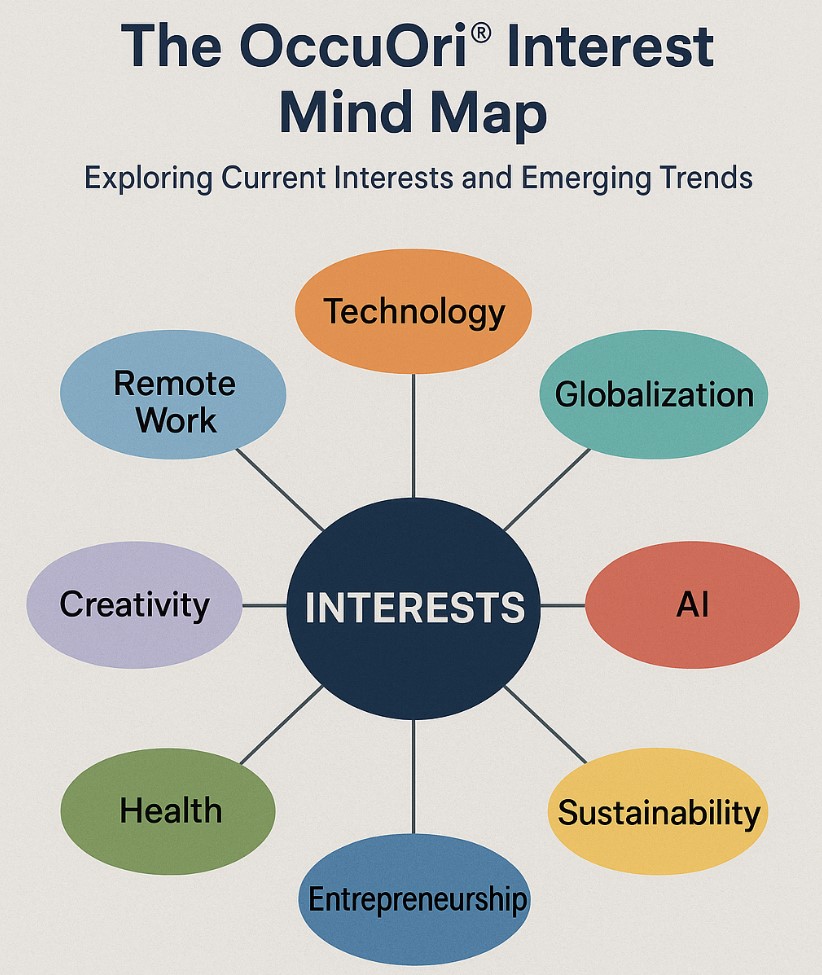
The OccuOri® Interest Mind Map is structured around a
central organizing concept, typically the user’s core motivation or overarching
purpose. From this center, primary branches radiate outward, representing key
domains such as interests, skills, values, preferred work environments, and
awareness of emerging trends. Each branch can be further subdivided, allowing
for detailed exploration of specific activities, industries, or roles. This
flexible, hierarchical structure supports both breadth and depth, enabling
users to capture the full complexity of their interests and aspirations (Brown
& Lent, 2020).
A distinctive feature of the Mind Map is its explicit
integration of career adaptability, a construct defined by Savickas and Porfeli
(2012) as the psychosocial resources individuals use to manage career tasks,
transitions, and traumas. The four dimensions of adaptability—concern, control,
curiosity, and confidence—are woven into the mapping process, prompting users
to consider not only what interests them now, but also how they can prepare for
and respond to future changes in the world of work. For example, the “concern”
dimension encourages users to think proactively about their future, while
“curiosity” invites exploration of new fields and opportunities. “Control”
emphasizes the importance of agency and decision-making, and “confidence”
supports the development of self-efficacy in pursuing career goals.
The Mind Map also encourages users to identify and
reflect on emerging trends, such as the rise of green jobs, digital
transformation, and the growing importance of diversity and inclusion in the
workplace (World Economic Forum, 2025). By mapping interests in relation to
these trends, individuals can proactively position themselves for new
opportunities and avoid the pitfalls of obsolescence. This forward-looking
approach is particularly valuable in a labor market characterized by
volatility, uncertainty, complexity, and ambiguity.
The process of creating and revising the Mind Map is
inherently iterative and user-driven. There are no right or wrong answers;
instead, users are encouraged to revisit and update their maps as their
interests evolve and as new opportunities arise. This aligns with the
principles of self-determination theory, which emphasizes the importance of
autonomy, competence, and relatedness in fostering motivation and well-being
(Ryan & Deci, 2020). The Mind Map thus serves as both a snapshot of current
interests and a living document that evolves alongside the user’s personal and
professional development.
In practical terms, the OccuOri® Interest Mind Map can be
used in a variety of settings, including individual career counseling, group
workshops, educational planning, and organizational talent development. For
students, the Mind Map provides a structured way to explore potential majors,
extracurricular activities, and career paths, supporting informed
decision-making and persistence (Tracey & Robbins, 2006). For
professionals, the Mind Map facilitates reflection on career satisfaction,
identification of new opportunities, and planning for transitions or
advancement. For organizations, the Mind Map can inform talent management
strategies, succession planning, and the design of learning and development
programs.
The Mind Map’s visual format also supports collaborative
exploration and dialogue. Career counselors, educators, and mentors can use the
Mind Map as a shared language and framework for guiding conversations, setting
goals, and tracking progress (Brown & Lent, 2020). By making interests
visible and actionable, the Mind Map bridges the gap between self-reflection
and concrete action, empowering users to take ownership of their career
journeys.
Diversity, Inclusion, and Personalization in Career
Exploration
A key strength of the OccuOri® Interest Mind Map is its
commitment to diversity, inclusion, and personalization. Research by
Byars-Winston and Rogers (2019) demonstrates that cultural, gender, and
socioeconomic factors profoundly shape career interests, opportunities, and
outcomes. The Mind Map framework is designed to be culturally responsive,
allowing users to incorporate their unique backgrounds, identities, and lived
experiences into the exploration process. This not only supports equity but
also enriches the mapping experience, as diverse perspectives often lead to
more creative and innovative career pathways.
The importance of intersectionality in career development cannot be
overstated. Byars-Winston and Rogers (2019) found that the intersection of
race, ethnicity, and gender significantly influences science identity and
career aspirations among underrepresented groups. The Mind Map’s flexible
structure allows users to reflect on how their multiple identities interact
with their interests and goals, fostering a more holistic and authentic
approach to career planning.
Personalization is further enhanced by the Mind Map’s
iterative, user-driven approach. Users are encouraged to revisit and revise
their maps as their interests evolve and as new opportunities arise. This
dynamic process supports lifelong learning and adaptability, qualities that are
increasingly essential in a world where career paths are rarely linear and
where the ability to pivot is a key determinant of success (Savickas &
Porfeli, 2012).
The Mind Map also supports the cultivation of a growth
mindset, as described by Dweck (2008). By framing interests and skills as
malleable rather than fixed, the Mind Map encourages users to embrace
challenges, seek feedback, and view setbacks as opportunities for learning and
growth. This mindset is particularly valuable in the face of career shocks,
transitions, and the need to acquire new competencies in response to changing
market demands.
Motivation is another critical dimension of
personalization. Ryan and Deci (2020) emphasize that intrinsic
motivation—engaging in activities for their inherent satisfaction—leads to
deeper learning, greater creativity, and sustained engagement. The Mind Map
helps users identify those interests that are truly self-driven, supporting the
development of autonomy and resilience. At the same time, the Mind Map
acknowledges the role of extrinsic motivators, such as financial rewards or
social recognition, and encourages users to reflect on how these factors
interact with their intrinsic motivations.
The Mind Map’s emphasis on harmonious passion, as
articulated by Vallerand et al. (2003), further supports well-being and
sustainable engagement. By helping users distinguish between interests that are
integrated into their broader life goals and those that may be driven by
external pressures, the Mind Map promotes balance and long-term satisfaction.
Ho, Wong, and Lee (2011) found that employees who experience harmonious passion
are more likely to demonstrate cognitive engagement and high performance, underscoring
the practical benefits of aligning work with authentic interests.
Impact, Innovation, and Future Directions
The OccuOri® Interest Mind Map is more than a tool for
self-discovery; it is a catalyst for action, innovation, and lifelong growth.
By making interests visible and actionable, the Mind Map supports informed
decision-making about education, training, and career moves. It also serves as
a valuable resource for career counselors, educators, and mentors, providing a
shared language and visual framework for guiding conversations and setting
goals (Brown & Lent, 2020).
Empirical evidence underscores the value of such
approaches. Students and professionals who align their interests with their
academic and career choices experience greater satisfaction, persistence, and
success (Tracey & Robbins, 2006; Holland, 1997). Those who cultivate
harmonious passion and intrinsic motivation are more likely to thrive, even in
the face of uncertainty and change (Vallerand et al., 2003; Ho et al., 2011;
Ryan & Deci, 2020). As the workforce continues to diversify and evolve, tools
that support adaptability, inclusion, and lifelong learning will be essential
for both individual and organizational success (World Economic Forum, 2025;
Savickas & Porfeli, 2012).
The Mind Map’s innovative use of visualization
techniques, inspired by natural systems, sets it apart from traditional
assessment tools. Beale et al. (2006) argue that nature-inspired visualizations
are particularly effective for representing complex relationships and
facilitating pattern recognition. The organic, branching structure of the Mind
Map mirrors the way interests and competencies naturally develop and
interconnect, making the process of exploration more intuitive and engaging.
The Mind Map also aligns with contemporary trends in
career development theory, which emphasize self-management, proactivity, and
the construction of meaning through narrative and reflection (Brown & Lent,
2020). Wrzesniewski and Dutton (2001) highlight the concept of job crafting,
where individuals actively shape their roles to better fit their interests and
strengths. The Mind Map provides a practical framework for this process,
enabling users to identify opportunities for crafting their work and pursuing
innovation within their current roles.
Looking to the future, the Mind Map is well positioned to
support the ongoing transformation of the world of work. The World Economic
Forum (2025) projects that the demand for skills such as analytical thinking,
creativity, and emotional intelligence will continue to rise, while routine
tasks are increasingly automated. The ability to identify and develop interests
that align with these emerging demands will be a key differentiator for both
individuals and organizations.
The Mind Map’s adaptability also makes it a valuable tool
for navigating career shocks and transitions. Wang, Liu, and Deng (2022)
discuss the relevance of social cognitive career theory in helping individuals
manage uncertainty and change. By providing a structured yet flexible framework
for exploring interests and setting goals, the Mind Map supports the
development of self-efficacy, outcome expectations, and adaptive career
behaviors.
Finally, the Mind Map’s emphasis on innovation and
knowledge creation resonates with Leonard-Barton’s (1995) concept of
“wellsprings of knowledge.” By encouraging users to explore the intersections
of their interests, skills, and values, the Mind Map fosters the conditions for
creativity, problem-solving, and the generation of new ideas. This is
particularly important in a knowledge-based economy, where the ability to
innovate is a key driver of competitive advantage.
Conclusion
In a world where the pace of change is accelerating and
the boundaries between disciplines are increasingly blurred, the ability to
understand, organize, and act on one’s interests is a critical asset. The
OccuOri® Interest Mind Map offers a visually engaging, evidence-based framework
for exploring current interests and emerging trends, empowering users to craft
meaningful, adaptable, and future-ready careers. By integrating the latest
research in motivation, career development, and visualization, and by centering
diversity and inclusion, the Mind Map stands as a vital resource for anyone
seeking to navigate the complexities of the modern workforce with confidence
and purpose.
The Mind Map’s foundation in person-environment fit,
harmonious passion, intrinsic motivation, and career adaptability ensures that
it is both scientifically robust and practically relevant. Its flexible,
user-driven structure supports lifelong learning and personalization, while its
commitment to diversity and inclusion makes it accessible and valuable for
individuals from all backgrounds. The Mind Map’s innovative use of
visualization techniques not only enhances self-reflection and strategic
planning but also fosters creativity and innovation, qualities that are
essential for success in the twenty-first-century economy.
As the world of work continues to evolve, the need for
tools that support adaptability, self-management, and proactive career
construction will only grow. The OccuOri® Interest Mind Map exemplifies the
future of career assessment: adaptable, data-informed, and deeply
human-centered. Its proven utility across educational, professional, and
organizational contexts ensures that it will remain a cornerstone of effective
career guidance for years to come. By enabling users to visually map their
passions, skills, values, and aspirations, the Mind Map empowers them to make
well-informed, strategic decisions about their education, training, and
professional growth.
Ultimately, the OccuOri® Interest Mind Map is more than a
tool; it is a catalyst for lifelong learning, innovation, and fulfillment. In a
world where the only constant is change, those who can understand and act on
their interests will not only adapt to the future of work but will help shape
it—turning curiosity into capability, and aspirations into achievement.
References
Beale, R.,
Hendley, R. J., Pryke, A., & Wilkins, B. (2006). Nature-inspired
visualisation of similarity and relationships in human systems and behaviours. Information
Visualization, 5(4), 260–270. https://doi.org/10.1057/palgrave.ivs.9500135
Brown, S. D.,
& Lent, R. W. (Eds.). (2020). Career development and counseling: Putting
theory and research to work. Wiley.
Byars-Winston,
A., & Rogers, J. G. (2019). Testing intersectionality of race/ethnicity ×
gender in a social–cognitive career theory model with science identity. Journal
of Counseling Psychology, 66(1), 30–44. https://doi.org/10.1037/cou0000309
Dweck, C. S.
(2008). Mindset: The new psychology of success. Ballantine Books.
Ho, V. T.,
Wong, S.-S., & Lee, C. H. (2011). A tale of passion: Linking job passion
and cognitive engagement to employee work performance. Journal of Management
Studies, 48(1), 26–47. https://doi.org/10.1111/j.1467-6486.2009.00878.x
Holland, J. L.
(1997). Making vocational choices: A theory of vocational personalities and
work environments. Psychological Assessment Resources.
Leonard-Barton,
D., & Leonard-Barton, D. (1995). Wellsprings of knowledge: Building and
sustaining the sources of innovation. Harvard Business School Press.
Ryan, R. M.,
& Deci, E. L. (2020). Intrinsic and extrinsic motivation from a
self-determination theory perspective: Definitions, theory, practices, and
future directions. Contemporary Educational Psychology, 61, 101860. https://doi.org/10.1016/j.cedpsych.2020.101860
Savickas, M.
L., & Porfeli, E. J. (2012). Career adapt-abilities scale: Construction,
reliability, and measurement equivalence across 13 countries. Journal of
Vocational Behavior, 80(3), 661–673. https://doi.org/10.1016/j.jvb.2012.01.011
Tracey, T. J.
G., & Robbins, S. B. (2006). The interest–major congruence and college
success relation: A longitudinal study. Journal of Vocational Behavior, 69(1),
64–89. https://doi.org/10.1016/j.jvb.2005.11.003
Vallerand, R.
J., Blanchard, C., Mageau, G. A., Koestner, R., Ratelle, C., Léonard, M.,
Gagné, M., & Marsolais, J. (2003). Les passions de l’âme: On obsessive and
harmonious passion. Journal of Personality and Social Psychology, 85(4),
756–767. https://doi.org/10.1037/0022-3514.85.4.756
Wang, D., Liu,
X., & Deng, H. (2022). The perspectives of social cognitive career theory
approach in current times. Frontiers in Psychology, 13, 1023994. https://doi.org/10.3389/fpsyg.2022.1023994
World Economic
Forum. (2025). The future of jobs report 2025. https://www.weforum.org/publications/the-future-of-jobs-report-2025/
Wrzesniewski,
A., & Dutton, J. E. (2001). Crafting a job: Revisioning employees as active
crafters of their work. The Academy of Management Review, 26(2),
179–201. https://doi.org/10.2307/259118
Nha Viet Institute
Research report: The OccuOri® Interest Mind Map: Exploring Current Interests and Emerging Trends
Date: March 15, 2025