

Introduction
In an era defined by rapid technological change, global
economic shifts, and evolving workforce expectations, the traditional notion of
a linear career path has become increasingly obsolete. Today’s professionals
face a world where 79% believe that continuous learning is essential for career
growth, and nearly half of all job skills are projected to change within the
next few years (World Economic Forum, 2025). As organizations and individuals
alike grapple with the demands of upskilling, adaptability, and purpose-driven
work, the need for innovative, effective career development tools has never
been more urgent.
Yet, despite the proliferation of digital resources and
guidance platforms, many individuals still struggle to identify and pursue
career paths that truly align with their passions, values, and strengths. This
gap is particularly acute as the workforce becomes more diverse and as the
demand for personalized, skills-first approaches intensifies (OECD, 2025;
Roberson et al., 2024). Against this backdrop, the OccuOri® Passion Wheel
emerges as a timely and transformative solution. By integrating visual mapping,
self-reflection, and evidence-based assessment, the Passion Wheel empowers
users to navigate the complexities of modern career development with clarity
and confidence.
This paper explores the theoretical foundations,
empirical support, and practical applications of the OccuOri® Passion Wheel.
Drawing on the latest research and global trends, it demonstrates how this tool
not only addresses the pressing needs of today’s workforce but also offers a
powerful, inclusive, and adaptable approach to career exploration and lifelong
professional growth.
Theoretical Foundations and Design of the OccuOri®
Passion Wheel
The OccuOri® Passion Wheel is grounded in the latest
advances in career assessment and development, leveraging visual and
interactive methodologies to foster self-awareness and strategic
decision-making. Visual mapping tools, such as the Career Development Wheel,
have been shown to help individuals externalize their thoughts, recognize
connections between interests and skills, and set actionable goals for growth
(Grove Tools, 2025). This approach is particularly effective for diverse
learners and those seeking to integrate multiple facets of their identity and
aspirations into their career planning.
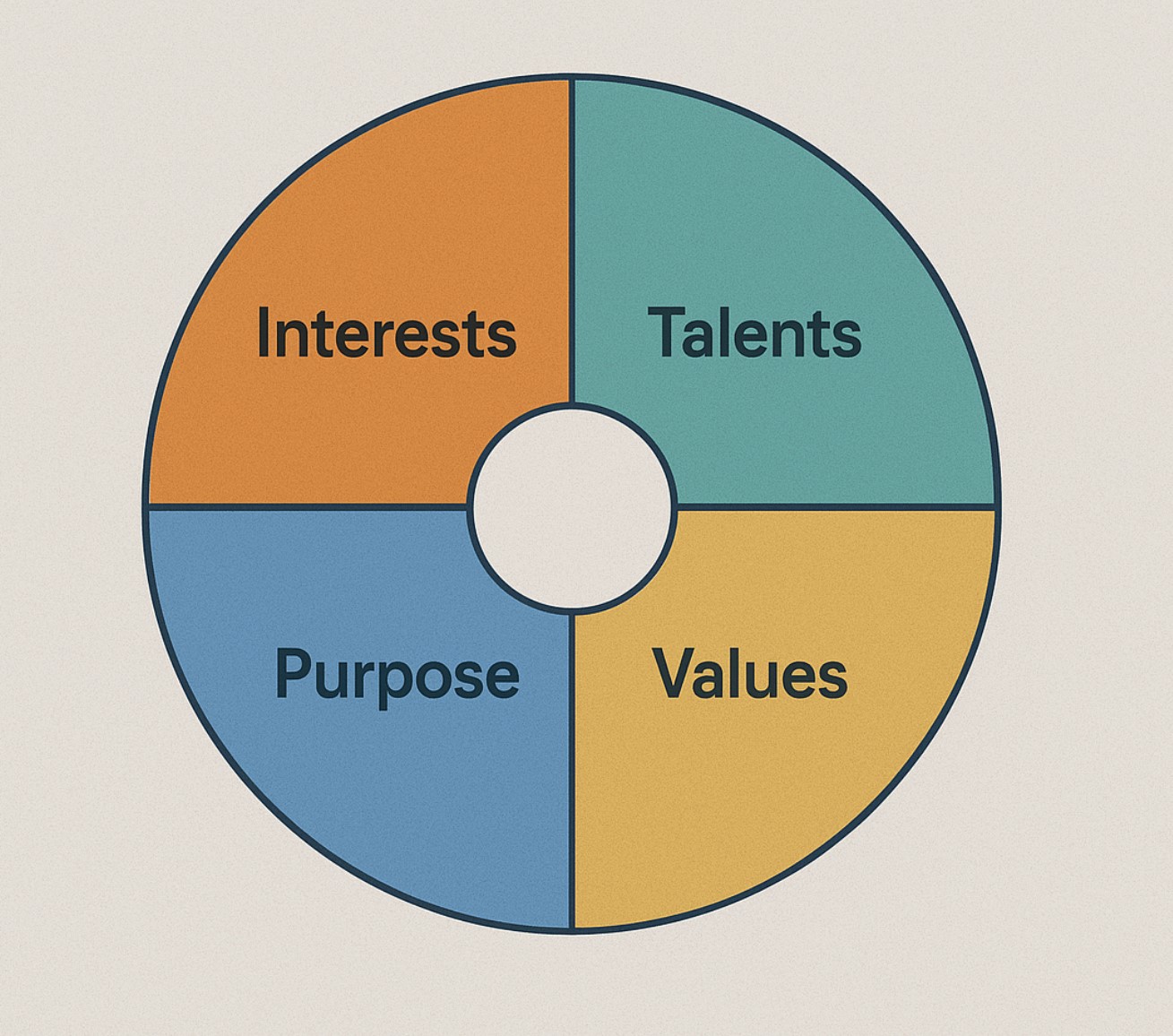
The Passion Wheel’s design invites users to reflect on
their interests, values, and motivations across a spectrum of occupational
domains, from technology and healthcare to creative arts and social services.
By responding to targeted prompts and mapping their responses onto the wheel,
individuals gain a clear, intuitive overview of their passion profile. This
process not only catalyzes deeper self-reflection but also supports more
targeted and meaningful career exploration (Stoltz & Barclay, 2019).
Contemporary research underscores the importance of
aligning career choices with personal purpose and intrinsic motivation.
Purpose-based career coaching, for example, has been shown to significantly
enhance job satisfaction, engagement, and work-life integration (Otu, 2024).
The Passion Wheel operationalizes these insights, guiding users beyond
surface-level preferences to discover what truly drives them in their
professional lives.
Modern career guidance systems increasingly integrate assessments of
aptitude, interest, and intelligence to provide nuanced, individualized
recommendations. Fuzzy logic-based career guidance systems, for instance, have
demonstrated that incorporating interest alignment leads to higher motivation,
satisfaction, and success among students making career decisions (Kulkarni et
al., 2016). The Passion Wheel’s multidimensional approach is thus
well-supported by empirical evidence and best practices in the field.
Crucially, the Passion Wheel is designed with inclusivity
and cultural responsiveness in mind. Recent scholarship highlights the need for
career tools that address the diverse experiences and identities of users,
integrating intersectionality and cultural context into the decision-making
process (Roberson et al., 2024; Yao & McWha-Hermann, 2025). By offering a
flexible, adaptable framework, the Passion Wheel supports equitable career
development for individuals from all backgrounds.
Empirical Evidence: Effectiveness and Impact of Career
Development Tools
A robust body of research affirms the effectiveness of
structured career development interventions in enhancing employability,
self-efficacy, and long-term career success. Longitudinal studies on career
development learning (CDL) have found that CDL significantly improves students’
perceived employability, with human capital—such as educational attainment and
cultural understanding—serving as a key mediator (Ho et al., 2022). Initiatives
like internships, industry projects, and job application support not only
increase students’ confidence but also improve their understanding of the labor
market.
Career planning courses further demonstrate measurable
improvements in career readiness, self-assessment, and goal setting (Stebleton
& Franklin, 2017). The U.S. Department of Labor’s meta-analysis of 46
career pathways impact evaluations provides additional evidence, showing that
structured career interventions lead to higher educational attainment,
industry-specific employment, and short-term earnings (Department of Labor,
2022).
The literature increasingly advocates for a holistic
approach to employability, recognizing that personal characteristics, academic
achievements, and graduate skills all contribute to career outcomes (Li, 2024).
Effective career development tools must therefore address multiple dimensions
of human capital, including knowledge, skills, cultural awareness, and
self-efficacy.
Visual and passion-based assessment tools, such as the Passion Wheel, have
been shown to enhance self-reflection, engagement, and the integration of
identity, interests, and values into career planning (Stoltz & Barclay,
2019; Grove Tools, 2025). These tools are particularly valuable when used
alongside professional guidance, supporting individuals in making informed,
strategic decisions about their education and career trajectories.
The practical utility of the Passion Wheel extends across
sectors, from technology and healthcare to creative arts and education. The
adoption of digital career development tools is accelerating, with applications
ranging from AI-powered job matching to online credentialing and simulation
(OECD, 2025; World Economic Forum, 2025). In creative fields, visual mapping
helps individuals articulate their unique value and navigate non-linear career
paths, while in education and social services, such tools support diverse
populations, including those facing barriers to employment.
Practical Applications and Global Trends
The OccuOri® Passion Wheel is designed for use in a
variety of educational and professional settings, including schools,
universities, career counseling centers, and professional development programs.
In educational contexts, the tool guides students in selecting majors, courses,
and extracurricular activities that align with their authentic interests and
long-term aspirations. Research shows that students who perceive a strong
alignment between their studies and personal passions are more likely to persist,
achieve higher academic performance, and report greater satisfaction (Ho et
al., 2022).
For career planning and job search, the Passion Wheel
provides actionable insights that inform the selection of industries, roles,
and organizations. By clarifying which fields resonate most strongly with their
passions and values, individuals can target their job search more effectively
and pursue opportunities likely to yield long-term satisfaction and growth.
This targeted approach not only increases the likelihood of finding a
fulfilling career but also enhances motivation and engagement throughout the job
search process.
As individuals progress in their careers, their interests
and motivations may evolve. The Passion Wheel’s design encourages regular
reflection and updating, supporting ongoing professional growth and
adaptability. Purpose-driven work, where individuals freely choose to engage in
roles they love, has been shown to boost engagement, creativity, and
productivity, while reducing turnover intentions and negative work-related
emotions (Otu, 2024).
The effectiveness of any career assessment tool depends on its validity,
reliability, and cultural relevance. Advisors and organizations must ensure
that tools are validated for diverse populations and used in ways that promote
equity and inclusion. Attention to systemic factors such as socioeconomic
status, cultural background, and access to resources is essential for
supporting all individuals in exploring a broad range of career options
(Roberson et al., 2024).
Global trends further validate the relevance of the
Passion Wheel. Reports from the World Economic Forum and OECD emphasize the
need for skills-first approaches, lifelong learning, and adaptability in the
workforce. The Future of Jobs Report 2025 identifies the growing importance of
self-assessment, upskilling, and personalized career guidance in navigating the
changing world of work (World Economic Forum, 2025). Similarly, the OECD’s 2025
report highlights the shift toward prioritizing skills and interests over
traditional qualifications, further supporting the use of tools like the
Passion Wheel in contemporary career development (OECD, 2025).
Conclusion
As the world of work continues to evolve at an
unprecedented pace, the imperative for individuals and organizations to invest
in effective, evidence-based career development tools has never been clearer.
The OccuOri® Passion Wheel stands at the forefront of this movement, offering a
dynamic, inclusive, and research-backed approach to career exploration and
growth. By enabling users to visually map their passions, skills, values, and
aspirations, the Passion Wheel not only fosters self-awareness and motivation
but also empowers individuals to make informed, strategic decisions about their
professional futures.
The evidence is compelling: structured career development
interventions enhance employability, engagement, and long-term success
(Department of Labor, 2022; Ho et al., 2022). Visual and passion-based tools,
when thoughtfully designed and inclusively implemented, bridge the gap between
personal aspirations and the realities of the modern labor market (Grove Tools,
2025; Stoltz & Barclay, 2019). In a world where 94% of employees would stay
longer at companies that invest in their growth and where skills and values
alignment are paramount, the Passion Wheel is not just a tool—it is a catalyst
for meaningful, purpose-driven careers (World Economic Forum, 2025; OECD,
2025).
Ultimately, the OccuOri® Passion Wheel exemplifies the
future of career assessment: adaptable, data-informed, and deeply
human-centered. Its foundation in current research, commitment to diversity and
inclusion, and proven utility across diverse contexts ensure that it will
remain a cornerstone of effective career guidance for years to come. As we
navigate the complexities of the twenty-first-century workforce, tools like the
Passion Wheel will be essential in helping individuals not only adapt to change
but thrive—connecting their authentic passions to rewarding and sustainable
professional pathways.
References
Department of
Labor. (2022). A meta-analysis of 46 career pathways impact evaluations.
https://www.dol.gov/agencies/eta/research/publications/meta-analysis-46-career-pathways-impact-evaluations
Grove Tools.
(2025). Career development wheel and strategic visioning: Tools for growth.
Grove Tools, Inc. https://grovetools-inc.com/blogs/news/career-development-wheel-and-strategic-visioning-tools-for-growth
Ho, T. T. H.,
Le, V. H., Nguyen, D. T., Nguyen, C. T. P., & Nguyen, H. T. T. (2022).
Effects of career development learning on students’ perceived employability: A
longitudinal study. Higher Education, 1–19. https://doi.org/10.1007/s10734-022-00933-6
Kulkarni, A.
U., Potadar, A. M., Gaonkar, A. R., & Kumar, A. (2016). Fuzzy logic based
career guidance system. International Journal of Computer Science and
Information Technologies, 6(Special Issue on Advances in Computer Science
and Engineering and Workshop on Big Data Analytics), 01–04.
Li, Z. (2024).
A critical examination of the use of ‘capitals approach’ in graduate
employability research. Critical Studies in Education, 0(0), 1–17. https://doi.org/10.1080/17508487.2024.2443527
OECD. (2025). Empowering
the workforce in the context of a skills-first approach. OECD Skills
Studies. https://doi.org/10.1787/345b6528-en
Otu, M. S.
(2024). Effect of purpose-based career coaching on career decision-making. Current
Psychology, 43(31), 25568–25594. https://doi.org/10.1007/s12144-024-06247-3
Roberson, Q.,
Hoff, K., Pyram, R., & Holmes, J. (2024). Diversity in the career
lifecycle: A review and research agenda. Journal of Vocational Behavior,
151, 103998. https://doi.org/10.1016/j.jvb.2024.103998
Stebleton, M.
J., & Franklin, M. (2017). Positive impact of career planning courses:
Applying narrative strategies to empower teaching and practice. National
Career Development Association. https://www.ncda.org/aws/NCDA/pt/sd/news_article/143685/_PARENT/CC_layout_details/false
Stoltz, K. B.,
& Barclay, S. R. (Eds.). (2019). A comprehensive guide to career
assessment. American Counseling Association.
World Economic
Forum. (2025). The future of jobs report 2025. https://www.weforum.org/publications/the-future-of-jobs-report-2025/
Yao, C., &
McWha-Hermann, I. (2025). Contextualizing career development: Cultural
affordances as the missing link in social cognitive career theory. Journal
of Vocational Behavior, 159, 104114. https://doi.org/10.1016/j.jvb.2025.104114
Nha Viet Institute
Report: The OccuOri® Passion Wheel: A Contemporary, Evidence-Based Approach to Career Exploration and Development
Date: March 15, 2025